
Announcement
Introducing the Global Disinformation Policy Database Explorer
What do governments mean when they use the word “disinformation”? How about “fake news”? What do they do to address these concerns?
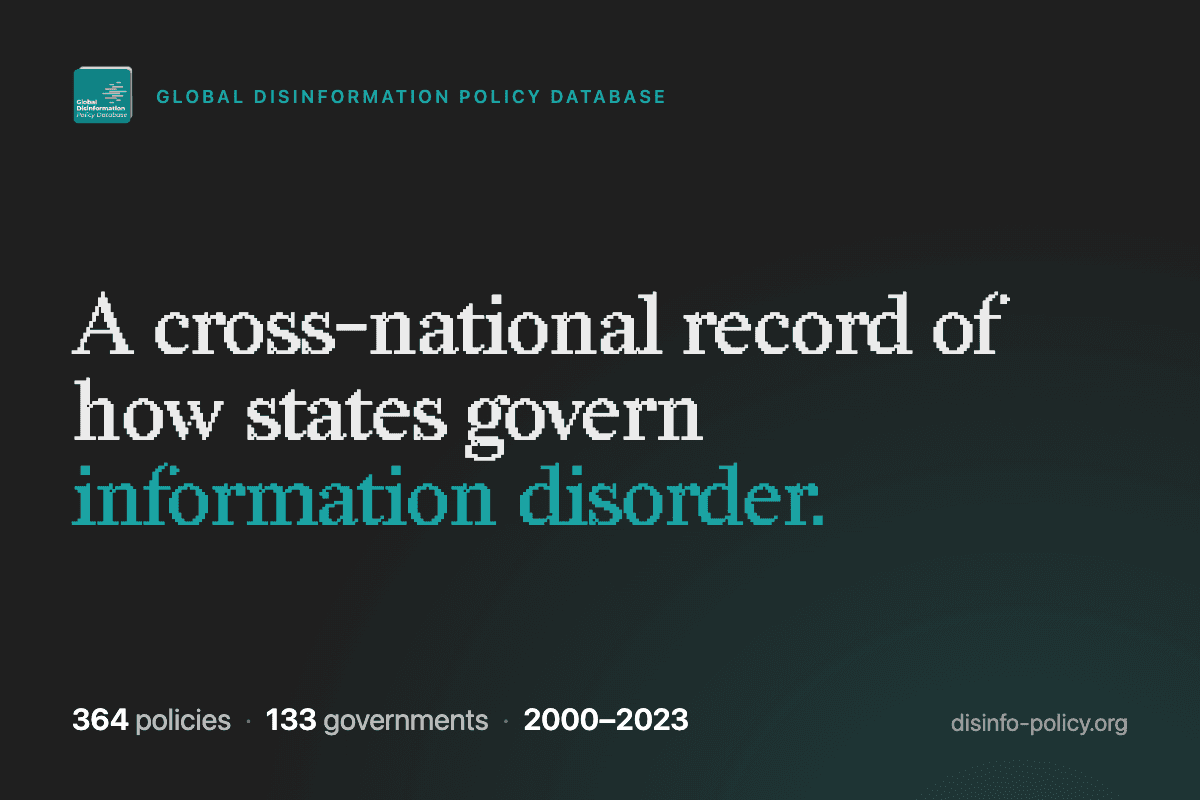
The Global Disinformation Policy Database (GDPD) Explorer is now available at disinfo-policy.org. It brings together 364 policies adopted between 2000 and 2023 across 132 countries and the European Union, with tools to compare definitions, explore government responses, and follow records back to their sources.
The Explorer is for anyone interested in how governments address false and misleading information. It is designed to be useful for researchers, journalists, policymakers, civil society organizations, and students.
Disinformation policy presents a basic challenge for comparison: governments can use the same word while targeting different information, different behaviors, and different harms. Looking only at whether a country has a “disinformation law” can obscure those differences. It can also overlook responses involving education, research, or institutional support.
The GDPD makes those choices visible. Its records describe how policies define the problem, which instruments they use, what institutions they involve, and what liability provisions they contain. The Explorer lets you examine those features together.
In the Definitions browser, for example, you can compare Ireland’s 2022 Electoral Reform Act with Ethiopia’s 2020 Hate Speech and Disinformation Prevention and Suppression Proclamation. The Irish definition connects disinformation to false or misleading electoral information, deception, and threats to the integrity of an election or referendum. The Ethiopian definition connects it to false speech, knowledge or reasonable knowledge of falsity, and the likelihood of public disturbance or violence.
Those differences give rise to new questions. What makes information subject to the policy? What must someone know or intend? Which harms justify government action?
Open the Irish policy record or the Ethiopian policy record to examine the coded instruments, institutions, and liability provisions. Then follow the source links to read the underlying documents. Shared labels may become the starting point for more precise comparisons.
Other questions offer different ways to begin:
- Looking for education and institutional-support approaches? Explore policies with capacity-building instruments, including Denmark’s 2022 Media Agreement, whose record documents support for digital literacy, fact-checking, and research on technology’s effects on democracy.
- Researching earlier responses to synthetic media? Browse policies targeting deepfakes to find election measures, national strategies, and regulations within the database’s coverage through 2023.
The GDPD documents policy design and adoption. Assessing how a measure was enforced, whether it achieved its goals, or what effects it had requires further evidence. Its coverage ends in 2023, so the records provide a historical foundation for research rather than a complete account of current law.
The project was led by Ryan Williams at the University of Texas at Austin, with contributions from dozens of student researchers through the Global Disinformation Lab and the LBJ School of Public Affairs. Their work finding documents, interpreting policy language, and working through difficult cases made this resource possible.
You can explore the dashboard, download the underlying data from Harvard Dataverse, or read the companion research and codebook.